Showing posts with label strategy. Show all posts

Friday, April 13, 2018

Do your creative briefs have solid insights?

Insight is defined as (by Merriam-Webster)
1 : the power or act of seeing into a situation : penetration
2 : the act or result of apprehending the inner nature of things or of seeing intuitively
Solid creative briefs contain insights. But, sometimes, those insights are less than insightful. But as the sage Bill Bernbach said:
“At the heart of an effective creative philosophy is the belief that nothing is so powerful as an insight into human nature, what compulsions drive a man, what instincts dominate his action, even though his language so often can camouflage what really motivates him.”

In many cases, planners and strategists are responsible for pulling together the creative brief and digging up the insights. But, that's not always the case. Often, little or no research is done and the brief becomes just a list of demographic data and generic information that does not help the brief.

Avi Dan's piece "The Heart Of Effective Advertising Is A Powerful Insight" might be 5 years old but, it hits on a truth that is still true today (and probably for the rest of time).
"A great creative brief inspires, intrigues and provides the fertile soil from which powerful ideas can sprout. It does so with clarity, conciseness, and with a definite point-of-view. The brief should tell the creative team what it wants them to do, what is expected of them. As the creative brief has the power to spark amazing ideas, and ideas are what advertising is all about, it is essential that the CMO and its team immerse themselves in its creation."
And, a key part of the brief is the insight. It can take a creative team into fertile, inspirational ground that would not otherwise be explored.

As a creative, the insight is one of the first things I look for in a brief. As a creative director, I've worked with strategists and account managers to help make sure that the team has a true insight to work from that can help drive the creativity of the work in interesting directions.

So, What is a good insight?

Let's skip good, and go to straight to great. Great insights provide richness to a strategy and provide a unique perspective into the mindset of the target audience. They help put the creatives in the shoes of the audience they are trying to reach.

Examples of ads developed from insights showcases how a successful marketing campaigns move and inspire by resonating deeply with a brand’s target audience using inspiring consumer insight rooted in complex data. They looked at brand campaigns like Activia: It Starts Inside, Always: Keep Going #LikeAGirl, and Spotify: 2018 Goals.

Giving marketers the tools to create ideas that stick, in-depth data is often where the best campaigns begin. Just one fundamental truth about your consumer can inspire a powerful message that lasts.

"Insights illuminate, but they don't have to be deep", says Andy Davidson, who is Head of UK Practice at the global insight and brand consultancy Flamingo.

"In developing a useful insight, consider human needs", explains Nick Hirst, Head of Planning at creative agency Dare.

In "How to write a Creative Brief that will inspire great creative on your brand" by Beloved Brand, they state: "The smart brief frames the consumer insights with the word “I” that forces you to get into their shoes and put the insight in quotes that forces you to use their voice. These insights add more depth to the story of the consumer so the creative team can build stories that connect with your consumer. The best ads are those where you can almost see the insight shining through the work."

This is what makes a great insight. It's the combination of the:
1) Things we read (Facts & Data)
2) What we see (Observations)
3) What we hear (Consumer Voice)
4) What we sense (Emotional Zones)
5) Life moments (Day in the Life)
These five things come together to create an insight statement that is also counterpoint to the consumer paint point.

According to this piece there are four characteristics of a good insight:
1) the "A-ha!"
An insight differs from an observation in the fact that it is not immediately visible or ‘evident’, but that it only becomes clear when you are actually confronted with it. A strong insight is equal to a sort of ‘Aha’ experience: a combination of surprise and something familiar. It entails a view on something which was implicit all that time. To get to these ‘Aha’ moments, you need a creative and multidiscipline approach.

2) It's Me
The second basic aspect of a strong consumer insight is relevance. A strong insight automatically calls for familiarity, sometimes even to the extent that you may even learn things about yourself that you were not aware of before.

3) Tension
Behind every strong insight lies a need to improve an existing situation. In other words: it’s not just about being relevant; consumers should also feel a need to change something to an existing situation.

4) Insight ≠ idea
An insight is the start of possibly hundreds of ideas. It is a source of inspiration for branding, communication, innovation and customer experience. The easier you manage to come up with different ideas that start off from your insight, the stronger your insight is.

The end result of a great insight, is possibly great creative. It certainly doesn't guarantee it, but it significantly increases the chances that the creative team will craft something that has a strong resonance with the target because of it.

Tuesday, September 12, 2017

Making Banking More Social

At the end of last week I attended the Argyle 2017 Financial Services Forum: Marketing & Technology Innovation conference to talk about making banking more social.

Speaking off the cuff in an interview format, I know there are things I could have discussed but didn’t do to the lack of having notes available.

So I decided I would hit on some of what I talked about, but also touch on things I didn’t talk about.

Banking and finance are typically not leaders when it comes to technology and digital. Often, they leverage that which has worked in other industries first. It makes sense; the risk is lower. And we’re talking about very risk-adverse folks.

Where many other brands are today in terms of social, the banking and finance world (on average) is about 5 years behind but, working to catch up. The thing is, in the digital world, 5 years is a lot. And playing catch up means you'll always be behind. Brands need to start looking at ways they can leapfrog to get ahead.

Social touches all stages of the funnel.

I will start by clarifying, the marketing funnel is not the same as a customer journey. But, if we’re thinking about how we want to create awareness, drive education, and get people to act, we have the ability to do it all in this channel. Social can also be a key component to retention, an oft overlooked, yet powerful component of the overall process.

It requires building bridges across the silos that exist within your organization. Thinking about how each touchpoint creates a full story for your brand as they see different content within their social streams.

Think how can you narrate the story in the way that best suits your business needs, as well as providing value to your customers.

Social leads your online customer service.

Understanding the role social can play in customer service is critical. Customer expect to get their issue resolved through a message on Facebook or a direct message on Twitter.

Enabling your social teams to do so, and actually take action for certain items (like a password reset), can have an incredibly positive impact on your call centers. It can also help to improve the perception of your business by being able to solve things with less back-and-forth and in a more immediate manner.

Social provides key insights through data about your customers.

Leveraging the information about your fans and followers across your social networks can provide key insights to help drive future campaigns, and product development. You can discover what other brands they like (including your competitors) and gain tremendous psychographic learnings to apply to your marketing on and off social media.

Social is emotional.

From showing empathy through customer service to showcasing emotion tied to your brand, social is driven by the heart more than the mind.

It's a place to show you understand your customers; it should be relatable and relevant. And, it's a place for customers to show how they feel about your brand.

Social requires the right mindset.

There's more to social than just putting out a post on your platforms. It is a way of thinking about your business to create and deepen connections through relationships. It's also a way to leverage data that exists and use it in ways that surprise and delight.

Just because you're in the financial industry and there are a lot of barriers with compliance and regulations, there are always opportunities to think creatively about how to use social, whether it is in a program you launch or in the way you use the API data to do something that reduces friction for customers.

Overall, there is a lot more to think about with social and banking but, this is a start. Thankfully, banks have started to look outside their own industry for inspiration as well. Other highly regulated industries like insurance, have made great strides in how they create engaging and meaningful social campaigns that deliver for the business.

Banking can get there, too.

Wednesday, August 30, 2017

Reading Roundup: Week 8/28/17

Here are a few things of interest I've come across and have read in the past week...
Meet the 3 types of people who will launch your culture of growth:
Read the article to learn about The Pioneer, The Champion, and The X-Team.

Google Rolls Out Video Previews for Quick Searches:
Read about changes in the Google app for Android and Chrome on Android. When video results show up in the video carousel, just like text snippets for text results, you’ll see video previews.

5 Tips from Twitter to Boost Campaign Performance with In-Stream Ads:
Read to find out how creative teams can make the most of Twitter’s new ad offering, using research-backed best practices.

Generation Z Speaks Their Minds:
Read why, according research, there are four big cross-cultural themes that drive this generation: Diversity, Digital detox, Justice, and Nationality.

Design Principles: a guide to less shitty feedback:
Read and learn how design principles can help the creative process. "Design Principles are a set of statements that communicate what we want from a project or product. It’s a way for everyone to agree on a couple of core principles that the work should be measured by. By determining these ideas early on, you create a framework that will help you take design decisions and give constructive feedback."

Monday, August 21, 2017

Micro-Moments and Your Brand

Is your brand ready to handle micro-moments?

"Micro-moments have been accelerating consumer expectations for “right here, right now” experiences. People take for granted that information is at their fingertips and tailored to their specific needs. But the thing about human beings is they never stop wanting that little bit extra. It’s becoming evident that they’ll keep raising the bar, wanting more useful information, more personalization, more immediacy. My team wanted to dig into these evolving expectations and understand how consumer behavior has changed since we first introduced micro-moments."
- From Think With Google

Google groups micro-moments into three ways the data takes shape: well-advised, right-here, and right-now. It's possible your brand has something in motion today will suffice for passable mico-moment experiences. But, it's important to review the current customer experience and understand what hurdles you may have to overcome to meet these expectations.

Well-advised

Customer Behavior: People are using their mobile phones to research their purchases, for things as mundane as toothbrushes (yes, even a parity product!). Google's research even shows that searchers are using qualifiers, such as "best toothbrush". This means they're not just seeking out feedback about the item, but they're looking for crowd-sourced solutions in their results.

What to Consider: Check your content marketing and look over what you have currently and consider with the impact this could have for SEO results and rankings. If people care about the best product or service, you want your brand associated with this list, be it from John Doe's blog or Consumer Reports. Another piece to consider is the way you are overseeing customer reviews - take a look at how you are managing it and evaluate if you need to improve your current process. Be sure your teams are bringing forward thinking that helps your customers find more useful information to stay competitive.

Right-here

Customer Behavior: People expect brands to gather enough contextual information to deliver location-specific responses. They know you have information because other brands (not even your competitors) do. If Yelp can know where I am, why can't my mobile banking app? You know that it's snowing where I am, so make the information you show me relevant to my situation. It's not about a competitive set - customers expect all brands to be able to deliver at the same level as an

What to Consider: Review the data you have accessible and explore interaction points where you can better apply the information to cut out unnecessary or redundant data inputs by customers. With new feature sets and product improvements, you should always put contextual personalization at the top of the list. Brands who use data to help customers find what they're looking for will be the ones to achieve success.

Right-now

Customer Behavior: Customers are using their mobile devices for immediate needs like last minute purchases (think: forgotten birthday!). Instant gratification is not just wanted in the purchase phase but delivery as well--just look at companies like Instacart and Amazon Prime Now.

What to Consider: Explore your current ecosystem and seek out opportunities to deliver on more instantaneous delivery. Ask your customers for inputs, too. They're a great resource to get suggestions to for improvement and can help highlight the best placement in the user experience for it. Continue to push for immediacy and find new ways to get the sense of instant gratification to your customers.

Do you have other tips or suggestions? Leave them in the comments.

Friday, August 18, 2017

What does it mean to be a customer-first company?

What does it mean to be a customer-first company?

Today, it seems like every company claims to be a customer-first company. But really, is that true?

During the past 5-10 years, the brands I've worked with talk about it in meetings, but many rarely followed up with real action. And, as they say, actions speak louder than words.

So, what are some key ways for a brand to bring the concept of customer-first to life?

IT STARTS WTIH YOUR WHY

Being a customer-first company means your products start at the point of solving (or creating) a customer need or desire. That means the brand's products or services are built around the customer, not creating something and then figuring out the customer base for it or backing into a strategy to answer the "why".

Many new companies that leverage technology have done just that. Look at AirBnB, Uber, and Amazon as examples for this. They exist because they figured out a way to solve a problem, not attempting to retrofit a need into their offering. When brands start with their "why", it provides a stronger platform for all other communication strategies to stand on.

CUSTOMER EXPERIENCE

Most people say they understand that every touch point someone has with your brand is part of the customer experience. But, for some reason, many companies seem to let certain areas within their business slack off when it comes to putting the customer first.

It's understandable that brands get caught up in their own language and often start speaking to themselves, and that's why outside partners (ad agencies, consultancies, etc) are usually brought in to help provide that outside point of view and convert the internal language into something that makes sense for the audience, in the audience's language.

Another is instances of sales. Yes, of course the company needs to make money and be profitable. But it should not be at the expense of deceiving customers or providing terrible experiences. (Although recent actions by certain companies in the airline industry may prove this wrong.)

UNDERSTANDING YOUR CUSTOMER

Knowing your customer is absolutely critical to being customer-centric. If you can't understand their wants and needs, you'll have a lot of difficulty proving that your brand is there for the customer. You need to understand their mindset, their passions and what makes them tick. You need to survey as many as you can to remove generalizations that come about from small data sample sizes. It's a brilliant company leader that then even takes the next step to spend time with their customers to get a direct line of contact to their voice, which leads me to...

CUSTOMER FEEDBACK

Brands that listen to their customers can make a big impact to their bottom line. Providing channels for customers to give feedback on their experiences gives you an opportunity to improve. It also allows for kudos to be shared with those who are doing things right. Transparency of the feedback loops can also provide a lift in customers' perception of the brand. And if you bring forward a feature or service that was requested by customers, it naturally allows for a proof point to highlight that aspect of the brand in marketing and advertising.

Sunday, September 04, 2016

On Project Management

No matter how great a creative team you've got, or how receptive your clients are to brilliant ideas, there's one very important piece to running a good creative department. That, dear readers, is organization.

Without it, you cannot meet client expectations. Delivering work late, unfinished or half baked due to rushing, being overloaded or understaffed doesn't result in good results or good feelings.

There are a few elements key to achieve great organization.

Strategy

A solid creative brief can help set the stage for understanding the overall scope of work. What kind of project does the budget allow for it to be? How long does the project of this kind take to execute? These questions begin to frame staffing needs and help with overall project needs.

But the brief should also be abel to answer questions such as, Who are you talking to? What are their challenges? What is the key message? What are the key benefits? Getting answers to these questions that will frame the creative process help the creative come faster and be more on pointe from the start. You end up with less need for iteration because you'll be closer to an answer that's on pointe.

Project Managers

I've often said that a good project manager (or traffic manager) is worth their weight in gold and then some. Someone who can wrap their head around deadlines and the intricacies of different disciplines helps keep the team on track.

Project Management Systems

No matter how amazing the project manager, having a great project management system is also critical. Tracking projects, organizing information, deadlines, and much more in one place so that everyone is held accountable for their deliverables.

To-do lists & Status Meetings

Getting the team together for a status meeting weekly (or more frequently, depending on the project) helps everyone align on needs, dependencies, and work loads. It also helps to keep ownership and roles and responsibilities clear for everyone involved. Each team member should be well aware of their own to-do lists--whether that comes from the project management system, their project manager, or out of their own head.

Having certain elements organized, allows for unorganized thinking. It frees up time to put toward finding the most creative solutions to a problem posed by a brief. It Reduces the amount of stress and helps create an environment of trust and professionalism.

Tuesday, December 23, 2014

Why you should focus less on Millennials

+Millennials (aka Gen Y) are the only generation to be talked about so much by ad folk. There weren't long articles about reaching the Gen X generation or Baby Boomers. What is the industry obsession with this audience? Why focus so much on this one group?

Let's look a bit at what defines a Millennial. Pew Research defines someone born in 1981. Wikipedia states that there are "no precise dates when the generation starts and ends. Researchers and commentators use birth years ranging from the early 1980s to the early 2000s." In May 2013, a Time magazine cover story identified Millennials as those born from 1980 or 1981 to 2000". And, a global generational study conducted by PwC (a network of member accounting firms) with the University of Southern California and the London Business School defined Millennials as those born between 1980 and 1995.

So, they range in age approximately from 18-33 years old. That's a big difference in life stages. Entering college vs. starting a family. Dating vs. settling down. Figuring out your life vs. growing your career. And when you look at how they're talked about, it seems many still focus in on that lower end, those in their early 20s...perhaps forgetting that the middle range is now mid 20s heading toward 30.

And this, to me, is why focusing on the psychographics is much more successful in terms of nailing down who you are talking to. I don't care if you're in college or retired. We are more defined by our passions and our activism, than our age. Sure, age adds color to what you know or don't based on experiences, but those who weren't tech savvy are catching up with those who are natives to the technological world. And at some point soon, that will be a moot point because every one will be digital natives.

I found this How Millennial Are You? quiz and I scored 83 out of 100, which means I'm Millennial. Actually I'm not (although only by a couple years), but it's because the questions were based on behavior...yes, psychographics.

Tuesday, December 16, 2014

Demographics vs. Psychographics

+ Demographics get so much more weight in our industry. And, I get it. They were the darling of the media world in the Mad Men heyday. But in this digital age, psychographics should be leading the way.

Let's start by looking at the differences between demographics and psychographics. Wikipedia defines demographics as such:
Demographics are the quantifiable statistics of a given population. Demographics are also used to identify the study of quantifiable subsets within a given population which characterize that population at a specific point in time. Demography is used widely in public opinion polling and marketing.
Typically this includes items such as: Age, Education level, Income, Geographic location and other types of concrete data similar to what one would find in census data.

Wikipedia also describes psychographics in the following way:
Psychographics as the study of personality, values, opinions, attitudes, interests, and lifestyles. Because this area of research focuses on interests, attitudes, and opinions, psychographic factors are also called IAO variables.
These are the less tangible data points. They are the things that make up the personality of the person.

Demographics make generalizations. And in some cases they can be valuable.
1) Geo-targeted needs: If your brand is local or regional, you need to focus your spend and messaging at a target that will purchase at your locations.
2) High-end, luxury goods: Most likely if your product or service has a big price tag, only those who can afford it will actually buy it.

Psychographics lump folks together based on beliefs, interests and the like. In the digital age, there are many more ways for people to connect around similar interests and share opinions about the brands that they use in relation to them (such as runners and shoes). Online ordering has removed the need to be local--if you have an online store front based out of Wichita, Kansas you can still have customers in Paris, France buying your goods. Even some items like cars can a stronger psychographic pull because gear heads can see luxury items as aspirational and they might not make a lot of money but would save it up to get the latest Audi or BMW to be car rich and life poor.

Psychographics transcend age and focus on behaviors. Someone who is 40 might be just as much a hard core gamer as someone in their late teens. You then need to develop communications that speak to that aspect of their passion, not to the fact that they are 40 or late teens. It can be trickier in some aspects but also much richer and relevant in others.

Strategies that focus on the behaviors and values of their customers provide brands a chance to connect with their customers at a deeper level than just looking at demographic data. Success is found when you find the right balance that allows you to be relevant to their needs.

Monday, August 18, 2014

This & That: Stuff to read 08.18.14

+
Surprise & Delight: What is it, and why marketers love it:
"When brands publicly (and randomly) reward their customers, they demonstrate that they genuinely care about their customers, and are offering a new and exciting product/experience. This in turn creates buzz and excitement around the topic."

Lessons of continuity and disruption in building brands:
"Fundamentals for creating a loyal brand remain largely the same:
  • Provide something that's useful to people in their lives. Save them time or money, perhaps, or give them a better experience.
  • Do it in a way that's likeable, and engaging. With human decision-making largely based on emotion, make a connection.
  • Show loyalty to those that embrace you. Over time, you'll earn their trust."
...where once marketers could create an external image for the brand through advertising, a brand today is largely defined by the culture and competency of the company behind it. That culture needs to live and breathe the brand.

Wrestling with the always on social web and trying to relearn the value of boredom:
"Even if spending that time staring off into space makes it feel like I’m not accomplishing anything worthwhile, I think I probably am — and there’s research that suggests I’m right: boredom has a lot of positive qualities.">

SnapChat's pitch deck to businesses.

Life and legacy of Peter Drucker.

Sunday, August 17, 2014

Lessons from Nestle's Share Your Goodness campaign

Take a peek at the "Why Nestlé’s “Share Your Goodness” is More Than Good" post from Rishad, Chairman of DigitasLBi and Razorfish for some nice insights. My favorite bit from him in this post is below:
  • Storytelling is critical: Both executions, particularly Adoption, is a well-honed story – a story with humanity that leaves enough unsaid that the viewer brings their own experiences into the experience and therefore it becomes more engaging.
  • Human insights are key: The core insight is really about how food is central to human bonding and social experience. In both commercials, food serves as a bridge, a connection, an expression of love and understanding between siblings, husband and wife and just people.
  • Smart marketers own the category benefit: Food is an effective way to share our goodness. This is the underlying emotional benefit of food, besides its ability to sustain us physically. By linking Nestlé to this underlying category benefit, Nestlé looks bigger, more purposeful and more relevant to life than just being a food manufacturer.
  • Break The Mold: Somewhere a client or a series of clients made some bold calls. First, they decided to launch the campaign online. Second, they approved story lines where the brand is the hero without the product being the hero or appearing all over the story. Third, they approved scripts that took on out of the ordinary topics. And finally, they understood that we live in a connected world and had their agencies seed, enable and leverage sharing.
  • Recognize and leverage the power of new media: Many marketers see digital and new media – even today in India and often around the world – as an after thought, an add-on or something one does to claim it is in the plan. The reality is that in places like India, which is the second largest market for Facebook with 100 million users (also Twitter’s and Linked In’s second largest market) and a highly mobile (soon in India 250 million smart phones), new media is as much media as old media and can allow for far more flexibility to create and distribute an idea. Why not start with the idea first and then determine the media rather than starting with the :30 or the print ad?
The only thing I will say is that "Good" and "goodness" are starting to become meaningless the more brands use them. As Anthony Bourdain would say, "it's ubiquitous".

Sunday, December 29, 2013

This And That 12.29.13

I'm the kind of person who tends to have over 10 tabs open in my browser at one time (usually it's more like 30+). This morning I caught up on some of these things and below are the ones worth sharing or checking out.

+ Watch for a few good things. 1) Make interesting things that people want to share. 2) Logos are not brands, brands are the sum of the things that they do and experiences you've had or heard about them.
QR Codes Kill Kittens, A Cautionary Tale for Creatives talk by Scott Stratten.
QR Codes Kill Kittens: A Cautionary Tale for Creatives from The 3 Percent Conference on FORA.tv

Creativity, Disruption, Storytelling in the Digital Age from The Guardian featuring Allison Arden of Ad Age and Chuck Porter of CB+P.
Creativity, Distruption, Storytelling in the Digital Age from The Guardian on FORA.tv

+ Cadence and Slang is a series of evergreen guidelines that advocate simplicity, consistency, and humanity in technology. You can get a free chapter to check out. Tempted to get the book (maybe I will).

+ "Predatory Thinking for Copywriters", a talk by Dave Trott at the 2013 Professional Copywriters' Network Conference.


+ Peter Thompson on Strategic Questions shares 8 tough questions to ask clients to get them going in the right direction with their strategy.

+ The Many Faces of Adaptive Design is a great read on the different uses people associate with the term "adaptive design".

+ Here's a handy toolkit from Hack Design for best tools online for design, UX, and more.

+ I came across this post, Job Stories Are Great But Personas Aren't Dead, which was a nice read but introduced "job stories" to me as a new term. That lead me to this blog post, Designing Features Using Job Stories, which basically introduced to me the idea that personas aren't as helpful as job stories. I'm not sure I really see the difference all that much besides tweaking the questions asked.

+ Content Marketing Predictions for 2014.


+ What Content Marketing Needs to Rule in the Post-Advertising Age.

+ 4 Reasons Apple's iBeacon Is About to Disrupt Interaction Design.

+ After the Digital Agency: The Three New Archetypes for Winning Agencies, which states that digital expertise isn't enough anymore--you must be customer-obsessed.

+ Notes from LukeW of An Event Apart event in 2012 by Kristina Halvorson's Content Strategy Roadmap presentation in which she talked about how to integrate content strategy into a typical Web design workflow. In my experience, this is a key thing. As well as understanding that content is not just copy. But that's another post. ;)

+ And here's an oldie from A List Apart, Reviving Anorexic Web Writing which is still very relevant, maybe more so with the content marketing buzz.

Wednesday, October 23, 2013

Innovation takes balls and trust

+ Innovation is something that many want, yet are afraid to do. Everyone wants to be the first to achieve a unique success, but no one wants to be the one to take the risk. Especially when it comes to brands. So many are followers or wait for someone else to do it first.

Which leads to a question of how do you get someone to become more comfortable with the uncomfortable state of innovation?

1) TRUST
You need to build trust between your agency and the client. And the client needs trust up through their internal chain of command as well. Without trust, you cannot overcome the challenge of becoming comfortable with the risk related to innovation.

2) DEVELOP A PROCESS
Create a path for innovation. It's not about random acts of innovation. Create a group of decision makers who will push through approvals quickly. The process should built in a way to be nimble, adaptable, and scalable. As you embrace more innovation, you'll want to be able to use the process in many different ways.

3) START SMALL
Blowing up a business plan isn't necessary to innovate. Start small. Take small risks. Learn from them. Discover areas where you can be more risky and leave more risk-adverse pieces of your business alone until you feel comfortable incorporating them into your innovation process.

4) LEARN, ADAPT, REPEAT
Innovation is partly about failure. You need to accept this and be ready to learn from your mistakes. Take the learnings and adapt them to increase your success rate, or bin the idea and start over from scratch. It's an iterative process that will not necessarily be a slam dunk on the first go.

Innovation takes many forms, but there is no reason your agency, client, or even you can't apply certain applications of innovation to your business models. It just takes the courage to jump in and start.

Friday, September 13, 2013

Content - The new darling

+ Content. It's a hot topic in the world of advertising and marketing. And it has been for the last couple years. But is it really something that groundbreaking?

I mean, think about it. What is content? Stories. Illustrations. Photos. Articles. Graphs. Videos. Games. Ads (yes, even those!).

It's pretty much everything. So why the headlines like "Content Is King" and the like? Fragmentation has a lot to do with it. We're fighting for eyeballs (yeah that sounds gross) across a broader spectrum of media.

But the basis for what that content is made up of really isn't anything new. What is new is the importance of creating good extraordinary and effective content.

Many brands still are willing to pay millions to get a TV spot produced, but they won't spend the necessary money to create extraordinary and effective content. Why? Well, some of it is ignorance, and some of it is the lack of understanding what it takes to do content well.

Think back to any TV ad you have viewed online. Maybe you took the effort to seek it out, or someone sent it to you. If you liked it, you shared it by either sending it directly to someone you know or posting it on a social network for others to see. And that's how even TV ads are part of the content matrix for a brand. It's not just about copy on a website or tweets. It's really all-encompassing at each customer touchpoint.

By now we should all be aware that anything that is liked (or even hated) will end up on the web in some form. Smartphones make it simple to snap a photo of a print ad, direct mailer, or record a video of a TV spot. Whether the brands are putting that content out there themselves, it is of no matter. The fact is that it will get out there. And there is an even bigger place than before, since the internet really has no geographic or demographic borders (well, mostly).

In my opinion, it's always been important to have extraordinary and effective content, no matter the media. It needs to Delight through entertaining stories, provide unexpected perks, and deliver exceptional experiences (virtual or real). It needs to Enlighten through education, awareness and utility. Yes, The age of Delightenment! ;)

So for me, this royal coronation of content seems like just another bit of drama that's missing the point.

It comes down to starting with a solid strategy, understanding your audience, and 360-execution.

Here are just a few articles I've found that go deeper into creating content strategies. Although most of them are focused solely on website content, they have themes that are applicable to any other content that is created:
Content Strategy: Optimizing Your Efforts For Success
5 Ways to Maximize the Value of your Content
Make Your Content Make a Difference

Wednesday, July 31, 2013

Welcome to the Age of Delightenment

+ Over the course of the last few weeks I've done some reading and some thinking. I've been reading about storytelling, about the digital state and lots of articles and opinions about where the ad biz is now and where its going.

The head-butting of traditional and digital. The conflicts of data and creativity. (yeah, see my last couple of posts ;) ) But where does it all lead us? This is probably the most important question. And I think the best way to describe it is not through words that associate themselves with channels. Nor is it claiming that any delivery channel is dead.

So what should we call this new era? How about The Age of Delightenment.

What is Delightenment? Simply put, it's ideas that delight and enlighten people, bringing together all the tools at our disposal. And like the Age of Enlightenment, it includes intellectual and creative thinking across different disciplines such as arts, sciences, and philosophy. It looks to connect to people based on a few insights that can drill down to deeper and more tactical executions.

Delight
  • Entertaining stories
  • Unexpected perks
  • Exceptional experiences (virtual or real)
Enlighten
  • Education
  • Awareness
  • Utility

And remember, these are channel agnostic and should be thought of first before figuring out the best way to execute them (obviously some work better in certain media than others.) And when any of these are done well, you'll find people will want to share what they like or learned.

What do you think? Let me know in the comments.

Tuesday, July 09, 2013

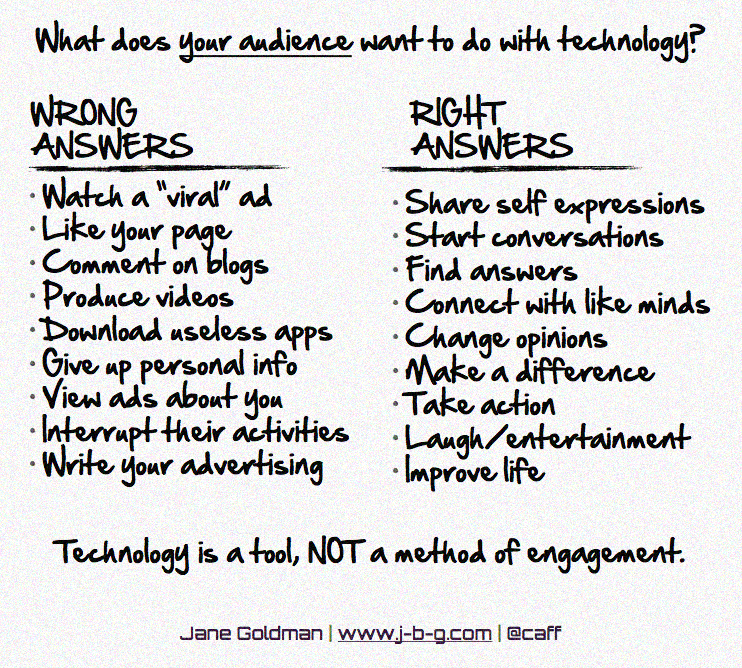
What does your audience want to do with technology?

+ So a teacher friend of mine posted this graphic around technology and teaching asking what you want students to do with technology, which resonated with me in regards to the way many expect audiences to engage, so I created the following:

Why storytelling isn't dead

+ I put this slideshare together to show that there is still importance in storytelling and ideas in advertising. We've become too focused on the technology and less on the story that drives it for the brands we work on. Being obsessed with data isn't a good thing either--it's what helps you build the strategy that the ideas and story comes from (or used to measure its success afterwards). Yes, it's important, but it's not the end all, be all. Neither is content. What is content but elements from stories and ideas? We can change the names and distribute them in different ways, but the initial premise is the same.


Monday, February 27, 2012

Branding and Digital: Part 3

+Part 3: The battle between digital and traditional

 Digital and traditional each held their own ground for a few years. Traditional was the lead dog, and digital was just there to translate (read: resize) the creative and ideas from TV and print into acceptable formats for the web. Digital was seen as the extension of something like direct mail, not broadcast. In some ways, this is a correct view, and in others, it's just wrong.

But, then, something started happening. Brands started to put more money into digital.
This meant that the websites and online experiences were given more credit as a real channel and it began to see more leeway in creative freedom. At least a little bit.

But traditional wasn't too keen on this.

People started seeing that the campaigns were happening in silos. Was there a connection to the way in which the campaign lived as a 30-second spot vs. a mircosite? Was that OK? Did it degrade the brand? The campaign? The message?

As brands started to reach out to digital only shops to do their interactive work, traditional agencies saw money that they thought was theirs going away. So many added in digital to their offerings to provide a full-service experience for their clients. In some cases, this worked. In others, brands still went to find other agency partners. Today, many brands have different agencies handling their different channels, including broadcast, print, POP, PR, promotions, digital and much more.
What that has lead to is increased competition between the different agencies.

Because the traditional folks have owned the branding side of the business for so long, clients are accustomed to going to those partners first to get the big idea. But sadly, this shouldn't always be the case anymore. Great creative minds have transitioned from the traditional to digital side and have the same grasp and understanding of branding and campaigns as their analog counterparts. The computer programmers and analysts began to be more balanced by the creative types moving into the digital space. And with them, they brought their background of branding and way of thinking.

Today, everyone in the business wants a piece of the digital cake, as it were.

Earlier last year, the folks at Forrester published an article titled The Interactive Brand Ecosystem. It recommends putting digital at the center of things, vs. TV, like in the good old days. Here's a snippet from the blog post about the article:
But the conditions that made TV the de facto heart of our brand messaging no longer exist. Today, interactive marketing is ready to lead your brand campaigns, for four key reasons:
The Internet has the scale to match any other channel. Eighty-three percent of American adults are now online (compared with 96% who watch TV), and online users spend marginally more time online each week than they spend watching TV. In total, I estimate that for every hour the average American spent watching TV in 2010, they spent about .9 hours online. I expect that when we get our 2011 survey data back, the channels will be neck-and-neck. The Internet has the depth to beat any other channel. Marketers no longer have to limit themselves to the quick brand impressions made by TV spots or billboards; their websites offer them all the depth they need to convey complex brand attributes and engage users. And consumers actually want brands to offer them this depth online—it’s why so many users go straight to Google to learn more about the brands they see advertised offline, and why the Internet is consumers’ most trusted source of brand and product information.
The Internet is more trusted than any other channel. What’s the marketing channel customers trust most? It’s not your TV ads, your print ads, your direct mail or even your Facebook page—it’s your own web site.
The Internet is a richer storytelling medium than any other channel. I love TV’s ability to tell a story—it’s the reason we still remember classic ads and taglines, and the reason I’ve dedicated much of my career to developing online video ad formats. But online goes a step further than TV, adding interactivity to the picture and offering marketers their single most compelling creative channel.
What you get with digital is the ability to meld different media types into one larger story. It's one of the things that I personally really like about it. But rarely is it used in that format (whether it's due to budget, agency fragmentation, or whatever). Digital now has the chops to take the lead and be the cornerstone of campaigns, instead of the ugly stepchild sitting in the corner with the dunce cap on.

I'm curious to see where all of this nets out in the next couple years. Brands are still trying to work it out with their agencies. Some clients want them all to play nice while behind the curtain the agencies are each vying for control.

Go back and read Branding and Digital: Part 1 and Part 2.
Related Posts Plugin for WordPress, Blogger...